The Shared Cupboard: Agreeing What Belongs There
A shared cupboard agreement clarifies who may use supplies, what stays private and where borrowed items go, so everyone can find what they need.
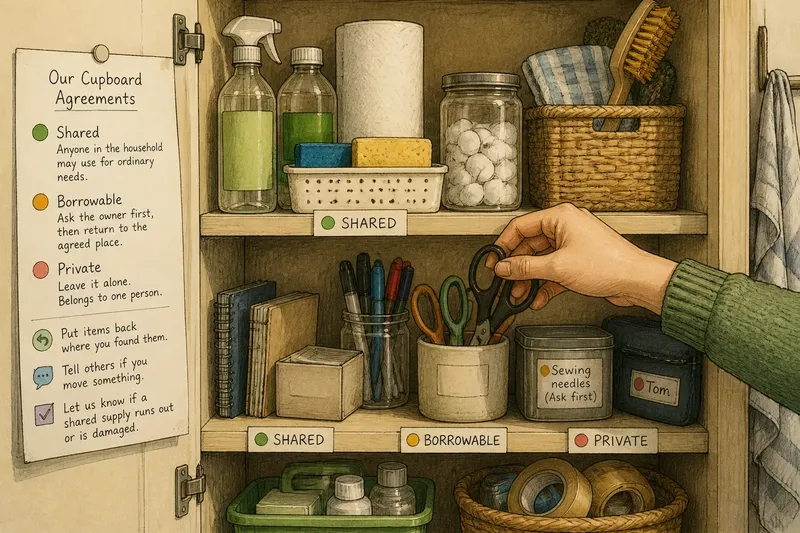
Who can use the spare batteries, and where should the scissors go when they’re finished? A shared cupboard agreement answers these everyday questions before they become a mysterious empty shelf or a household argument. Keep it brief, make it together, and describe how the cupboard actually works.
The aim is not to police every pencil or demand that everyone share everything. It is to agree which supplies are communal, which belong to someone, and what happens when an item leaves its usual place. Clear expectations make access easier while protecting personal belongings and the people who rely on them.
What belongs in the agreement?
Start with the cupboard’s purpose. Is it for shared cleaning supplies, stationery, spare household basics, or a mixture? Name the kinds of things it is meant to hold rather than trying to list every object. That gives newcomers and regular users a sensible boundary.
Next, settle three questions:
- Ownership: Is an item communal, personally owned but offered for borrowing, or private?
- Access: Who may use it, and are there any sensible limits?
- Return: Where does it go afterwards, and what should someone do if it is used up, damaged or missing?
Those are the agreement’s working parts. Add other details only when they solve a real point of confusion in your household or shared space.
How do you decide what is communal?
Set the agreement beside the cupboard and sort its contents by permission, not appearance. Two identical rolls of tape might have different owners: one bought for everyone and one kept for a particular person’s project. A shared shelf does not automatically make every item shared.
Use plain categories people can remember:
- Shared: anyone in the agreed group may use it for ordinary household needs.
- Borrowable: ask the owner first, then return it to the agreed place.
- Private: leave it alone, even if it is stored in the cupboard.
Decide what to do with items whose ownership is unclear. Set them aside and ask the likely owner rather than treating uncertainty as permission. If no one claims an item, agree on what to do together; do not quietly convert it into communal property.
Say you share a flat and find a tin of sewing needles beside the communal tape. You and your flatmates decide that the tape is shared, while the needles are borrowable only after asking their owner. When someone needs a needle, they check first and return the tin to the same shelf: there is a clear choice instead of a guess.
How should access work in practice?
Make permission proportionate to the item. Anyone might be free to take a communal dustpan, while a tool someone needs for a particular task may require a direct request. The agreement can identify which items need a quick message without requiring permission for every shared staple.
Consider who uses the cupboard and what access they reasonably need. In a family, children may use craft paper but need an adult’s help with certain supplies. In a shared workspace, people may use communal envelopes while keeping personal materials separate. State the relevant boundary simply; avoid rules for situations that are unlikely to arise.
Also agree what “using” an item means. Shared use might include taking a small amount for an ordinary task, but not removing the entire supply for a separate project. If someone needs to keep an item elsewhere for a while, a message or note can make its temporary location visible.
What should happen when something leaves the cupboard?
Choose a return habit that suits the item. Scissors can go back to their usual spot after use; a borrowed screwdriver might need to be returned directly to its owner. People should know where to look and whether an item is still in use.
Agree on a few practical courtesies:
- Return borrowable items to the place or person agreed in advance.
- If you move something temporarily, tell the people who may need it.
- If a shared supply runs out, leave a note or send a message rather than returning an empty container as if it were ready to use.
- If something is damaged, say so promptly and discuss what is fair before replacing it.
Keep responsibility for communal supplies realistic. The agreement can say who should flag an empty or damaged item without assigning one person an invisible, permanent maintenance job. If nobody has agreed to replace something, do not imply that a particular housemate or colleague must do it.
How can you make the agreement easy to use?
Write the decisions in a few plain sentences on a small card near the cupboard. For example: “The top shelf is shared household supplies. Ask before borrowing anything marked with a name. Put borrowed items back where you found them, and message the group if a shared supply runs out.” Adapt the wording to the actual arrangement rather than copying rules that do not fit.
Ask everyone who uses the cupboard to read the wording and point out anything ambiguous. “Ask first” needs a clear owner or contact; “put it back” needs a known home. A short conversation can settle those details before the card goes up.
It is not worth spending an afternoon designing a colour-coded permission system if a few sentences will do. A complicated chart can take more attention to maintain than the cupboard deserves. Use a marker or a note on the inside of the door, and keep only the distinctions that prevent genuine confusion.
What if the arrangement stops working?
Review the agreement when a new person starts using the space, the cupboard’s purpose changes, or the same uncertainty keeps coming up. Ask what happened and which sentence would have helped. Change that part together rather than adding a rule for every one-off mishap.
If someone repeatedly takes a private item or does not return a borrowed one, address the behaviour directly and calmly. A cupboard note can clarify expectations, but it cannot replace a conversation about trust, access or responsibility. Where a shared space has formal rules, follow the relevant household, workplace or organisational process as well.
What questions do people ask about a shared cupboard agreement?
Should everything in a shared cupboard be communal?
No. Storage location does not determine ownership, and people may need private supplies in a common space. Agree which items are shared, which may be borrowed with permission and which should be left alone.
Do people need to ask before using every shared item?
Not if the group has agreed that ordinary use is open to everyone. Reserve asking first for borrowable items or supplies with a specific owner, and describe that distinction plainly.
What should we do if nobody knows who owns an item?
Set it aside and ask the people who might recognise it. If ownership remains uncertain, agree on what to do together rather than assuming it is free to use.
How often should we revisit the agreement?
Revisit it when the people, purpose or recurring problems change. A rule that still helps people use the cupboard needs no ritual review; one that causes confusion should be revised.
What helps a shared cupboard agreement last?
A shared cupboard agreement stays useful when people can remember it as they reach for an item. Name the owner, permission and return habit in ordinary language, then put the note where the decision happens. If a detail is not causing uncertainty, leave it out.
Before writing the rules, ask the people who use the cupboard what they need protected and what they are happy to share. Keep a spare pen beside the agreement card so someone can update it when a new item or recurring question changes the arrangement.