Why Labels Work Better When They Name a Place
Labels that name a place make putting supplies away easier: give each item a clear home, then build a simple routine for keeping it there.
You can label a tin “batteries” and still leave it on the counter because the label says what it holds, not where it belongs. Labels that name a place answer the next question: where should this go when I’m finished with it? That small shift can make shared cupboards, drawers and supply boxes easier to use without buying another organiser.
Why name the home, not just the contents?
A contents label helps someone identify an item after opening a container. A place label gives them a destination before they put it away. “Spare batteries” describes a group; “hall cupboard, top basket” tells a person where the group lives.
The distinction matters most when supplies travel. Scissors may be used at the kitchen table, but if their agreed home is the desk drawer, the label can guide their return. Without that destination, “put away” means whatever seems convenient to the person holding them.
A place label can sit on a container, shelf edge or drawer front. Use the surface that remains visible when the container is being handled. If you already have a contents label, add the home rather than replacing useful information: “spare buttons — sewing tin on bedroom shelf”.
Which places make good homes?
Choose a location that fits how the supply is used and where it can be put back without rearranging other things. A home does not have to be a dedicated box; it might be a particular shelf, a hook, a drawer divider or a reused food tub inside a cupboard.
- Near the usual task: keep a tape measure with household mending supplies rather than wherever it was last used.
- Easy to reach: put frequently handled items where the intended user can return them comfortably.
- Clear enough to describe: “middle shelf, left basket” is more useful than “somewhere in the cupboard”.
- Stable in ordinary use: avoid assigning a home that is routinely cleared for another purpose.
- Suitable for the item: follow the product label and maker’s care directions where storage conditions matter.
Don’t spend an afternoon inventing a complicated naming system or making decorative tags for every object. Start with the few supplies that repeatedly drift, and use plain paper and removable tape until the location proves convenient.
How can you set up a home-label routine over a week?
Think of the first week as a short trial, not a cupboard makeover. Each stage has one job: notice the friction, choose a destination, make it visible and see whether people can follow it.
On the first day, what should you notice?
Watch for supplies that get left out, returned to different spots or searched for more than once. Note the item and the places it tends to land; don’t reorganise the whole area yet.
Say you keep finding the household scissors on the kitchen counter, by the post and beside the sewing tin. Their current location is unclear, so the useful question is not which label to buy but where everyone can return them after use.
On the second day, how do you choose a destination?
Pick a likely home based on where the item is used, who needs it and what space is already available. If the sewing tin is accessible and does not crowd the supplies inside, it may be a sensible place for the scissors.
Check that the choice works for other household members. If someone cannot reach the shelf or the spot is often occupied, choose a better location before labelling it.
On the third day, what should the label say?
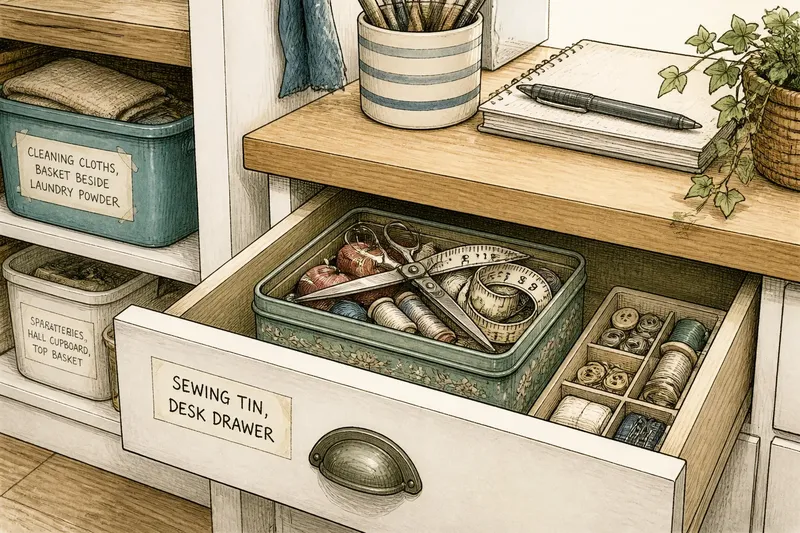
Write the destination in words someone can act on: “sewing tin, desk drawer” or “hall cupboard, lower basket”. Add the contents only if that information is useful; the place is the essential part of this label.
Attach a temporary label where it can be read while returning the item. A note on the shelf edge may be clearer than a small tag tucked behind the container.
For the rest of the week, what do you adjust?
Use the labelled home during normal routines and notice whether the item returns there. If it is repeatedly left elsewhere, ask whether the destination is inconvenient, unclear or simply no longer suited to how the supply is used.
Change the location or wording when the routine gives you a reason. Remove the temporary label if the place changes, so an old instruction does not send the next person looking in the wrong spot.
What should a useful place label include?
Keep the wording short enough to read at a glance, but specific enough to point to one destination. A useful label often names a room and a container, or a cupboard and a shelf.
- Room: “laundry cupboard”, not just “cupboard”.
- Distinct container: “blue tub” or “mending tin” when the cupboard holds several options.
- Position: “top shelf” or “left-hand drawer” if the location needs further direction.
- Contents, when helpful: add “spare buttons” so someone can confirm they have the right container.
Use the names people already use for the space. If your household calls a room the back room, a label using that phrase may be quicker to understand than a formal room name.
What if a supply belongs in more than one place?
Some items are genuinely shared between tasks. Rather than listing a string of possible homes on one label, decide whether one central home is practical or whether a small amount should live at each point of use.
If a single item travels, label its usual return point and make that location easy to reach. If a supply is commonly used in two rooms, agree whether it should be carried back after each use or kept in two existing, sensible spots. The label should describe the arrangement people can actually maintain.
For a shared cupboard, choose wording that avoids private shorthand. “Cleaning cloths, basket beside laundry powder” tells a guest or housemate more than “cloths go back there”. Naming the place makes the instruction usable even when the person putting things away did not take them out.
What do people ask about place labels?
Should a label name the contents as well as the location?
Add both when someone needs to identify the supply and find its home. If the container’s contents are obvious, a place label alone may be enough.
Should labels go on the container or the shelf?
Put the label where the person returning the item will see it. A container label travels with the contents, while a shelf-edge label can identify an empty home that needs to be kept available.
What if the chosen home stops working?
Move the supply to a more practical location and update or remove the old label. A label is a prompt for a current routine, not a reason to preserve an awkward arrangement.
Do I need to label every cupboard?
No. Begin with items that are often misplaced or areas used by several people, then add labels only where they resolve a real hesitation. An unlabelled drawer that everyone uses easily does not need extra instructions.
How do you keep the system useful?
When a room or cupboard changes, check the labels attached to the affected homes. Remove wording that no longer matches, especially if a container has moved or the household has given a space a different use.
For the next few weeks, treat repeated detours as information: a label may be too vague, or the designated home may be inconvenient. Adjust one location at a time and keep what makes returning supplies straightforward. The best labels that name a place are not the ones that cover every object; they are the ones that point clearly to a home people can use.